 DABEL5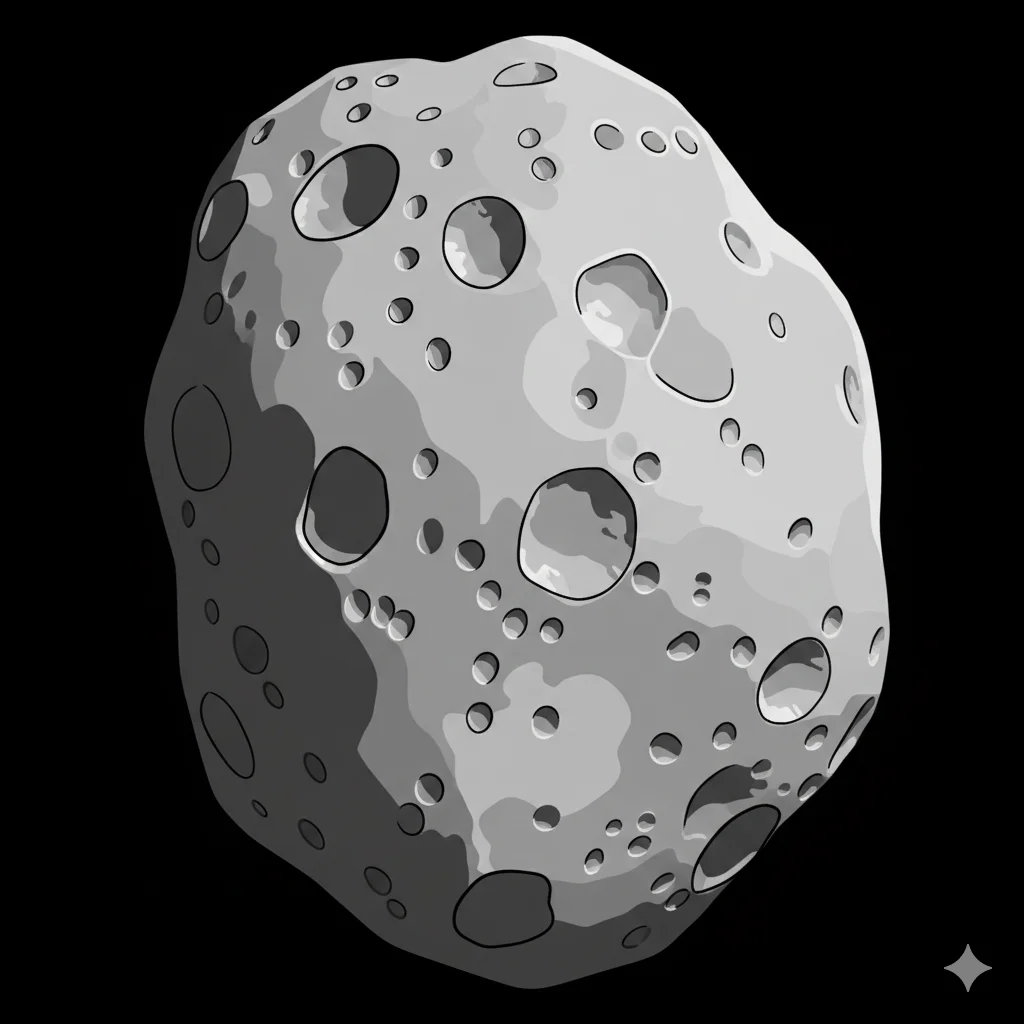
The EML5 Problem
In the previous post, we proposed EML5 (Earth–Moon L5) as the bootstrap site for a Dyson swarm. The plan: build the first mirrors from lunar resources (Al, Ti, O₂) and verify the self-replication loop with only 1.3 seconds of communication delay.
But there was a clear limitation: the Moon has no bulk Fe-Ni resources. Without iron-nickel alloy — the primary material for mirror frames and structural members — you cannot scale beyond a few thousand units.
So where do you get it?
1986 DA: A 3 km Chunk of Nickel-Iron
Why This Asteroid
| Parameter | Value | Significance |
|---|---|---|
| Classification | M-type (metallic), Amor-class NEA | Metal body + near-Earth |
| Diameter | ~2–3 km | Sufficient resource volume |
| Composition | Fe-Ni alloy 90%+ | Nearly pure metal (based on radar albedo, Ostro et al.) |
| Perihelion | 1.17 AU | Just outside Earth’s orbit — good accessibility |
| Orbital inclination | 4.3° | Close to the ecliptic plane — saves delta-v |
| Next close approach | 2038 (0.21 AU) | 12 years from now |
Estimated Resources
| Resource | Estimated Quantity | Use |
|---|---|---|
| Fe-Ni alloy | Billions to ~10 billion tons | Mirror frames, structural members, pipes, batteries |
| Platinum-group metals (Pt, Ir, Pd, Rh) | ~100,000 tons | Mirror protective coatings, catalysts |
| Gold (Au) | ~10,000 tons | Electronics, coatings |
| Silicates (SiO₂) | Slag fraction | Radiation shielding + silicon ingot feedstock |
| Sulfur (S), Phosphorus (P) | Trace | Chemical feedstock, semiconductor dopants |
Mercury vs. Asteroid: Why Not Mine a Planet?
“Wouldn’t dismantling Mercury give incomparably more resources?”
True. In total resource volume, there is no comparison. But the problem is the cost of extracting the first ton.
| Comparison | Mercury | 1986 DA |
|---|---|---|
| Escape velocity | 4.25 km/s | ~a few m/s |
| Surface gravity | 0.38g (heavy mining equipment) | Microgravity (lightweight equipment) |
| Surface temperature | Daytime 430°C | Cryogenic (easy to manage) |
| Resource composition | Mostly silicates, metal separation required | Fe-Ni 90%+ (nearly ready to use) |
| Mining method | Essentially a variant of Earth mining | Surface scraping and crushing |
Mercury is a planet. Large-scale mining from a 4.25 km/s gravity well is the space version of terrestrial mining. The equipment is heavy, the energy cost is high, and the complexity is enormous.
1986 DA is a microgravity metal nugget. Scrape the surface, crush it, bag it — done.
Zero Waste: Nothing to Throw Away
A core principle of this design: every component of the asteroid ore has an assigned purpose.
| Ore Component | Fraction | Use |
|---|---|---|
| Fe-Ni alloy | 90%+ | Structural members, mirror frames, pipes |
| Silicate slag | A few % | Radiation shielding (1 m thick) + silicon ingot feedstock |
| Platinum-group metals | Trace | Mirror protective coating (Rh), catalysts |
| Sulfur | Trace | Chemical feedstock |
| Phosphorus | Trace | Semiconductor dopants |
No sorting is needed. There is nothing to discard, so there is nothing to pick out. Ship the raw ore whole, then let the smelting process separate everything naturally. 100% utilization.
Even the packaging (Fe-Ni wire mesh) gets fed into the smelter upon arrival.
One-Line Summary
You do not need to mine Mercury for the billions of tons of Fe-Ni a Dyson swarm requires. A 3 km metallic asteroid will pass near Earth in 2038. Every single component is useful — an ideal raw-material body with zero waste.