 DABEL5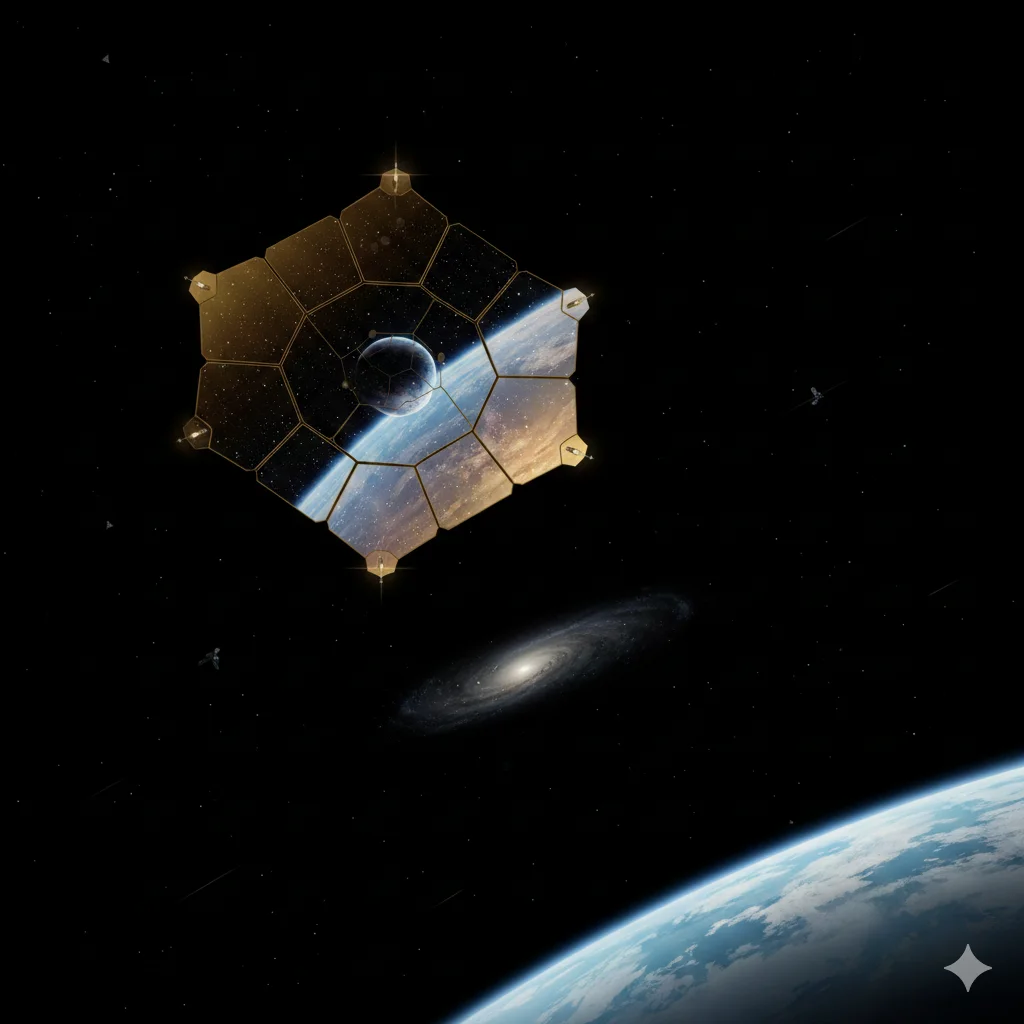
“So What’s in It for Earth?”
Eight posts have laid out the design. Bootstrap at EML5, mine asteroids, self-replicate at L5, generate electricity with turbines, manage the heat.
The obvious question follows: Why should anyone living on Earth care?
AI compute? Space habitation? The Kardashev scale? All valid — but none of them resonate with someone living in 2026.
This does: We can control Earth’s climate.
SEL1: The Control Point Between the Sun and Earth
Sun-Earth L1 (SEL1). Roughly 1.5 million km from Earth, toward the Sun.
| Parameter | Value |
|---|---|
| Location | On the Sun-Earth line |
| Distance from Earth | ~1.5 million km |
| Communication delay | One-way ~5 s → real-time control from Earth |
| Stability | Unstable (station-keeping required) |
| Station-keeping | The shade panel itself receives solar radiation pressure → attitude control via solar sailing |
Place a thin membrane at this point, and you get an adjustable shutter between the Sun and Earth.
Dual Mode: Cooling and Heating
Same location, same material — just change the panel angle:
[Cooling Mode — Counter Global Warming]
☀️ → [Shade Panel] → Block → 🌍    Block some sunlight → Cool the Earth

[Heating Mode — Counter Ice Age]
☀️ → [Concentrating Mirror] → Focus → 🌍   Focus sunlight on a specific region → Heat it
If warming is the problem, shade. If an ice age comes, concentrate. Bidirectional climate control.
Scale Calculation: Reversing 2°C of Warming
- Earth’s cross-sectional area: ~1.3 × 10¹⁴ m²
- Blocking 1.5% of sunlight: ~1.5–2°C reduction in global average temperature
- Required shade area: ~2 million km²
2 million km². The area of Mexico. Sounds enormous, but:
Mass of the Shade Panels
- Material: Fe-Ni ultra-thin film (thickness ~5 μm)
- Density: ~8,000 kg/m³
- Areal mass: 8,000 × 5×10⁻⁶ = 0.04 kg/m² (40 g/m²)
- Total mass for 2 million km²: ~80 million tons
The estimated resource mass of 1986 DA is billions to 10 billion tons. Less than 1% of a single asteroid can control Earth’s climate.
Comparison with Production Capacity
By the time tens of thousands of modules are operating, this production line is already running:
Smelter (SEL5/EML)
    ↓
Fe-Ni ultra-thin sheet production
    ↓
┌──────────────┬──────────────┬──────────────────┐
↓              ↓              ↓
Dyson mirrors   Radiator panels  Climate control panels
(Al coated)     (uncoated)       (uncoated)
Self-replication Module cooling   SEL1 deployment
No separate production line needed. The same factory stamping out mirrors and radiator panels produces climate panels from the same material — just with a different coating. A byproduct of the Dyson swarm.
SEL5 to SEL1: The Panels Fly Themselves
Manufacturing at SEL5, deployment at SEL1 — a 60° phase difference, roughly 150 million km. How do you move them?
The answer is the panel itself. At 40 g/m², the ultra-thin film has an area-to-mass ratio of 25 m²/kg — performance tens to hundreds of times higher than demonstrated solar sails (IKAROS ~0.001 mm/s², LightSail 2 ~0.058 mm/s²).
- Solar radiation pressure (1 AU): ~4.56 μN/m²
- Characteristic acceleration with reflection: ~0.23 mm/s²
- Time to accumulate Δv of 1 km/s: ~51 days
Panels manufactured at SEL5 sail to SEL1 under their own solar radiation pressure — no propellant. They reduce their orbital semi-major axis to shorten the orbital period, catching up across the 60° phase gap in 6–12 months. Once there, the same radiation pressure maintains their SEL1 orbit.
The Key: Reversibility
The most prominent geoengineering candidate under discussion today is stratospheric aerosol injection (SAI):
| Stratospheric Aerosol (SAI) | SEL1 Shade Panel | |
|---|---|---|
| Principle | Spray sulfuric acid particles into the stratosphere to reflect sunlight | Physically block some sunlight from space |
| If stopped | Abrupt rebound warming — once started, you can’t stop | Full restoration — remove the panels and it’s over |
| Side effects | Ozone damage, precipitation pattern disruption, uncertain crop impacts | Zero impact on atmospheric chemistry |
| Control precision | Low (wind disperses particles) | High (adjust panel angles for regional control) |
| Political consensus | Extremely difficult (uncertain side effects) | Relatively easier (because it’s reversible) |
Reversibility is everything. The core objection to geoengineering is “if it goes wrong, there’s no undoing it.” The SEL1 shade panel eliminates this concern at its root. Remove the panels, and sunlight returns to normal.
“Space Projects Need an Earth-Side Justification”
Historical pattern:
| Project | Earth-side justification |
|---|---|
| Apollo | Competition with the Soviets (Cold War) |
| GPS | Military precision navigation |
| ISS | Post–Cold War international cooperation symbol |
| Starlink | Internet access |
| Dyson swarm | ? |
“Kardashev civilization” isn’t a justification you can put in a NASA budget request. “Solving climate change” is.
- Hundreds of billions of dollars are spent on carbon reduction annually
- Diverting part of the climate budget to space-based climate infrastructure is a logical argument
- Can be positioned as the successor international cooperation project to ISS
And there’s a near-term deliverable. Once the first cluster is operating at EML, small-scale test shade panels can be produced immediately. Not an abstract future — a demonstrable early result.
Revisiting the Definition of Kardashev 1.0
Kardashev 1.0: “A civilization that controls energy at the scale of its own planet.”
Actively regulating your own planet’s climate — that is precisely that definition. Climate control capability is a natural byproduct of the journey toward Kardashev 1.0, not a separate project.
Mine asteroids → Build space factories → Replicate mirrors → Reach Kardashev civilization
                                                              ↑
                                              Save Earth's climate along the way
The Name of This Design
Eight posts have laid out a single design:
- Bootstrap at EML5
- Mine raw materials from asteroid 1986 DA
- Self-replicate Dyson swarm modules at SEL5
- As a byproduct, control Earth’s climate from SEL1
Dyson modules, Asteroid Belt & Earth L5.
DABEL5.
This design is called DABEL5.

One-Line Summary
The same factory on the Dyson swarm production line that stamps out mirrors and radiator panels can produce climate control panels with just a coating change. Place 2 million km² of ultra-thin Fe-Ni shade at SEL1 and you can reverse 2°C of warming. Remove it and everything goes back to normal. Less than 1% of a single asteroid’s resources. The dream of a space civilization and the solution to Earth’s problems sit on the same production line.