 DABEL5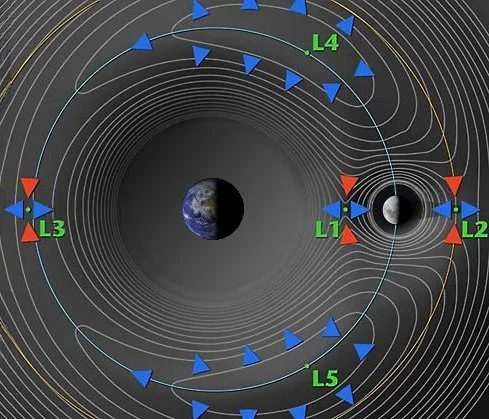
Where Do You Start a Dyson Swarm?
Dyson swarm discussions always start with the final form. Mercury disassembly, near-solar placement, multi-TW to PW output. That’s the framework Isaac Arthur’s series established, and most people take it for granted.
But before debating the finished K2 civilization, there’s a far more important question: where do you place the very first mirror?
Humanity currently sits at K 0.73. Here’s the math on where to take that first step.
Why EML5 (Earth-Moon L5)
3-Phase Roadmap
| Phase | Location | Distance from Earth | Comm Delay | Role |
|---|---|---|---|---|
| 1. Bootstrap | EML5 | ~380,000 km | ~1.3 s | First industrial base |
| 2. Scale-up | SEL5 (Sun-Earth L5) | 150 million km | ~8 min 20 s | Large-scale Dyson swarm |
| 3. Full-scale | Mercury | Variable | Variable | K2+ planetary disassembly |
Most discussions start at Phase 2 or 3. But there is no Phase 2 without Phase 1.
The Decisive Advantages of EML5
1. Communication Delay of 1.3 Seconds — Effectively Real-Time
Mercury has one-way delays of several to over ten minutes, plus solar conjunction blackout periods. EML5 is 1.3 seconds — close enough for remote control. You can begin without fully autonomous AI. This isn’t a nice-to-have; it’s decisive for bootstrap. Entrusting everything to autonomous manufacturing AI that has never been validated in space versus supervising in real-time from Earth — those are entirely different propositions.
2. Direct Lunar Resource Supply
| Resource | Source | Use | Transport Method |
|---|---|---|---|
| Aluminum (Al) | Regolith Al₂O₃ (~15%) | Mirror reflective coating | Mass driver |
| Titanium (Ti) | Ilmenite FeTiO₃ | Structural material (lightweight) | Delta-V ~2.5 km/s |
| Oxygen (O₂) | Reduction byproduct of the above | Life support | No chemical rocket needed |
| Silicates | Regolith | Radiation shielding | — |
Without the massive prerequisite of an asteroid mining fleet, you can launch resources directly from the Moon via mass driver. The delta-V from Moon to EML5 is ~2.5 km/s — achievable with chemical rockets, and zero propellant cost with an electromagnetic mass driver.
3. Easy Resupply from Earth
The delta-V from LEO to EML5 is far smaller than to deep space. Early equipment, electronics, and high-performance materials that can’t yet be manufactured in space can be supplied from Earth. The bootstrap phase doesn’t need to demand 100% self-sufficiency.
4. Gravitational Stability
EML5 is a Lagrange point of the Earth-Moon system. Station-keeping cost is near zero.
What Happens at EML5
First Goal: In-Situ Mirror Fabrication Capability
- Deploy the first seed mirror + smelting equipment from Earth to EML5
- Transport Al, Ti, and silicates from the Moon via mass driver
- Use the seed mirror’s concentrated solar thermal energy to vacuum-smelt lunar materials
- Use the output to fabricate a second mirror on-site — the starting point of the self-replication loop
Solar Environment
EML5 sits at the same 1 AU as Earth’s orbit. Solar flux is 1,361 W/m². It can’t match the 6.6x flux near Mercury (0.39 AU), but mirror lifespan and operating conditions are incomparably better.
Validation Phase
EML5 also serves as a technology validation stage:
- Does vacuum smelting actually work?
- Does the self-replication loop’s doubling period match calculations?
- Does mirror coating lifespan meet predictions?
All of this can be validated under supervision from 1.3 seconds away. Debugging with delays of minutes to tens of minutes in deep space is a completely different story.
Why Start at EML5
| Approach | Prerequisites for First Mirror | Risk |
|---|---|---|
| Mercury disassembly | Mercury landing, mining, escape, orbital deployment | Extremely high |
| Direct deep space | Asteroid mining fleet, fully autonomous AI | High |
| EML5 | Lunar mass driver, real-time Earth supervision | Lowest |
The key difference: if EML5 fails, you can fix it. At 1.3 seconds, a joystick still reaches.
But EML5 Isn’t Forever
EML5 isn’t a silver bullet. It’s optimal as a bootstrap site, but its limits are clear.
1. Earth’s Shadow
EML5 orbits in the same plane as the Moon (inclination 5.14°), passing opposite the Earth every ~27.3 days. When near the ecliptic plane, it enters Earth’s umbra and solar power is completely blocked.
Earth's umbra diameter at 384,400 km:
  r = R_earth - d × (R_sun - R_earth) / d_sun
  = 6,371 - 384,400 × 689,629 / 149,600,000
  = 6,371 - 1,772 = 4,599 km (radius)
  → Diameter ~9,200 km

Entry condition: ecliptic latitude < arctan(4,599 / 384,400) ≈ 0.69°
Lunar orbit inclination 5.14° → occurs only near ascending/descending nodes ±7.7° range
The geometry is identical to a lunar eclipse (offset by 60°, so it occurs at different times):
| Parameter | Value |
|---|---|
| Frequency | 2–3 times per year |
| Max duration per event | ~2.5 hours (central umbra transit) |
| Including penumbra | ~4.3 hours |
| Total annual downtime | 3–12 hours |
| Annual uptime | 99.86–99.97% |
A few hours of thermal storage enables uninterrupted operation. Not fatal, but the mere existence of a shadow is a limitation.
2. Small Stable Region
Due to the Earth-Moon mass ratio (81:1), EML5’s stable region spans only tens of thousands of km. Hundreds to thousands of modules fit, but beyond that, it saturates.
3. Lunar Resources Alone Aren’t Enough
The Moon has no bulk Fe-Ni resources. Iron-nickel alloy — the primary structural material for mirror frames — can only be obtained in bulk from asteroids.
| Resource | Moon | Asteroid (1986 DA) |
|---|---|---|
| Al, Ti, O₂ | Abundant | None / trace |
| Fe-Ni alloy | Nearly zero | 90%+ |
| Silicates | Abundant | Slag byproduct |
Early mirrors can use Ti frames + Al coating, but scaling beyond thousands of units is impossible without asteroid Fe-Ni.
4. Solar Perturbation
Solar gravitational perturbation makes EML5 quasi-stable rather than perfectly stable. Long-term station-keeping is required.
Constraint Summary
| Constraint | Severity |
|---|---|
| Earth’s shadow (3–12 hrs/year) | Low — mitigated by thermal storage |
| Stable region (saturates at thousands of modules) | Medium |
| No Fe-Ni | High |
| Solar perturbation | Low |
So, What’s Next?
EML5 is the optimal first step for a Dyson swarm. Communication delay of 1.3 seconds, direct lunar resource supply, Earth resupply capability — no better conditions exist for bootstrap.
But the limits are equally clear:
- 3–12 hours/year of Earth shadow downtime
- Stable region of tens of thousands of km — saturates at thousands of modules
- The Moon has no Fe-Ni — the wall for scale-up
At EML5 you validate the self-replication loop and grow hundreds to thousands of modules. The technology works. But you can’t grow any larger here.
So where is the next stage?