 DABEL5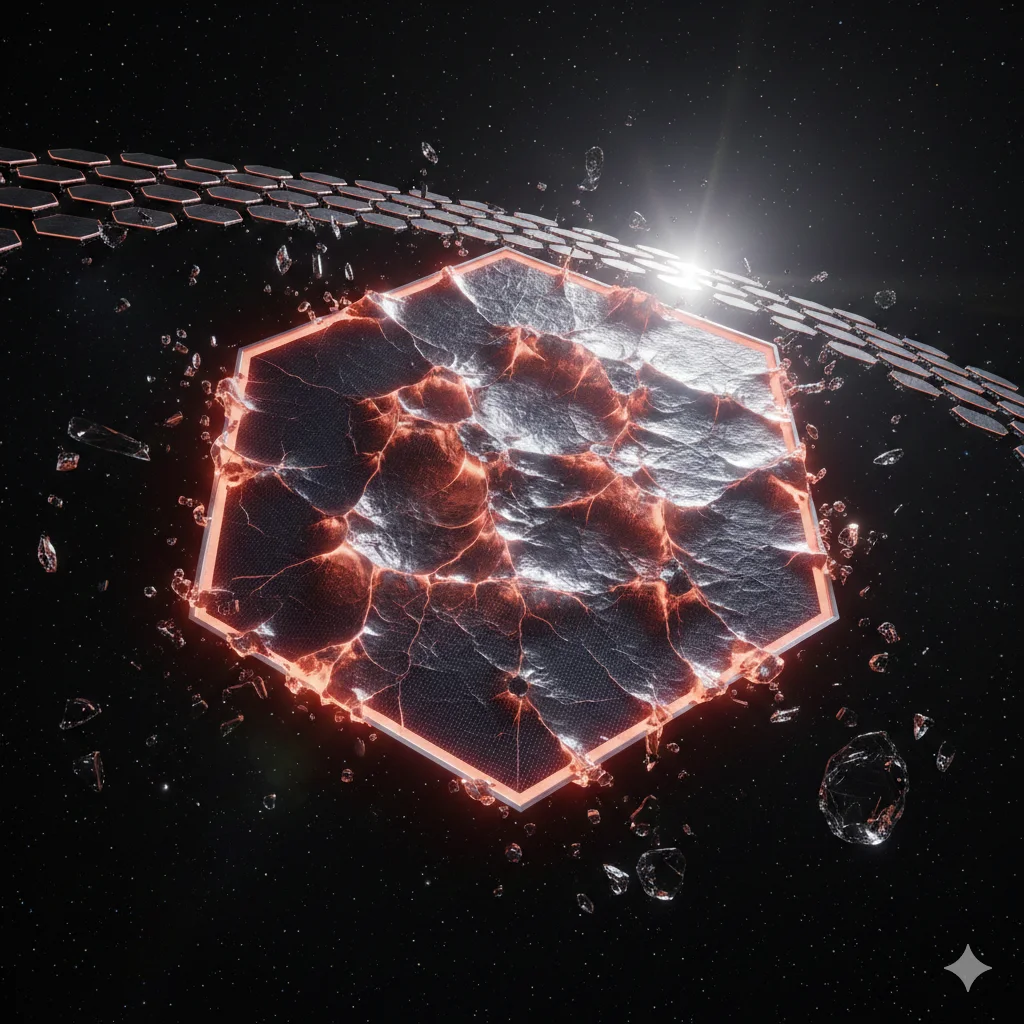
The 6.6x Advantage Isn’t Free
Mercury’s orbit (0.39 AU) receives 6.6 times the solar flux compared to 1 AU. The per-area efficiency is overwhelming. But mirrors don’t have 100% reflectivity — the absorbed energy is what kills them.
Absorbed Heat and Equilibrium Temperature
Energy absorbed and equilibrium temperature for a 90% reflectivity mirror (Stefan-Boltzmann, back-side emissivity ε=0.5 — for the uncoated radiator surface, not the Al-coated reflective face. If the radiator emissivity is lower, the temperature is even higher):
| L5 (1 AU) | Mercury Orbit (0.39 AU) | |
|---|---|---|
| Incident Flux | 1,361 W/m² | 8,940 W/m² |
| Absorbed (10%) | 136 W/m² | 894 W/m² |
| Equilibrium Temp | ~−10°C | ~150°C |
90–150°C is survivable for metals on its own. But the problem lies in what happens next.
Positive Feedback Loop (Thermal Runaway)
At 150°C, coating degradation accelerates. Al-substrate interdiffusion follows the Arrhenius law — it scales exponentially with temperature.
Reflectivity 90% → 894 W/m² absorbed → 150°C
  ↓ Coating degradation
Reflectivity 85% → 1,341 W/m² absorbed → ~190°C
  ↓ Accelerated degradation
Reflectivity 80% → 1,788 W/m² absorbed → ~230°C
  ↓ Al-substrate interdiffusion threshold breached
Reflectivity plummets → Mirror death
What if the same 5% reflectivity drop happens at L5? Additional absorption: 68 W/m². Negligible temperature change. The feedback loop never activates.
CME Pulls the Trigger
Solar wind density scales with the inverse square of distance. At 0.39 AU, it’s ~6.6 times the density at 1 AU.
The bigger threat is CMEs (coronal mass ejections). At 0.39 AU, a CME hasn’t had time to spread out — it hits the mirror at concentrated energy density. A single powerful CME can sputter the coating surface → reflectivity drops → thermal runaway begins.
For reference: the MESSENGER probe couldn’t survive at Mercury’s orbit without a ceramic sunshade.
Operational Reality Comparison
| L5 (1 AU) | Mercury Orbit (0.39 AU) | |
|---|---|---|
| Equilibrium Temp | −10°C (safe) | 150°C (degradation zone) |
| Effect of 5% Reflectivity Loss | +68 W/m² (negligible) | +447 W/m² (thermal runaway onset) |
| CME Tolerance | High | Low (6.6x density) |
| Expected Replacement Cycle | Decades+ | Years to ~a decade |
| Maintenance Logistics | Right next to L5 industrial cluster | Requires separate service infrastructure |
One-Line Summary
At Mercury’s orbit, a 5% reflectivity loss isn’t a 5% output reduction — it’s the signal that the mirror is beginning to die. At L5, it’s a rounding error.