 DABEL5
“Energy storage obviously means lithium-ion, right?”
A Dyson module collects solar heat with mirrors to spin turbines. It would be nice if the Sun shone 24/7/365, but reality disagrees.
- Eclipse: The EML5 base enters Earth/Moon shadow 2-3 times per year, totaling 3-12 hours
- Load fluctuation: Turbines respond slowly to sudden load changes. Without ESS, voltage wobbles on instantaneous demand swings
- Emergency shutdown: During mirror maintenance or turbine failure, critical systems – life support, AI, communications – cannot stop
- Maneuvering power: Tug docking and evasive maneuvers demand high burst power
A Dyson module cannot function without batteries. So which battery?
On Earth, the answer is obvious. Lithium-ion. Energy density, charge/discharge efficiency, lightweight – best on every metric. But for the same reason turbines beat solar panels in a previous article, the criteria are different in space.
Lithium-ion needs replacement every 10 years, and the nearest lithium mine is on Earth. On asteroids, iron and nickel are literally everywhere underfoot.
Earth Criteria vs Space Criteria
| Parameter | Iron-Nickel (Edison) | Lithium-Ion | What matters in space |
|---|---|---|---|
| Volumetric energy density | 30-60 Wh/L | 250-700 Wh/L | At 1 km² scale, volume is irrelevant |
| Gravimetric energy density | 30-50 Wh/kg | 150-270 Wh/kg | Stationary structure – doesn’t matter |
| Lifespan | 30-50 years | 5-15 years | Replacement cost in space is astronomical |
| Overcharge tolerance | Extremely high | Poor (thermal runaway/fire) | Fire in vacuum = total module loss |
| Over-discharge tolerance | High | Irreversible damage | Full discharge possible during eclipse |
| Local material sourcing | Possible (Fe, Ni, KOH) | Impossible (Li, Co, organic electrolyte) | Existence of the self-replication loop |
| Electrolyte | Potassium hydroxide aqueous solution (water-based) | Organic solvent (flammable) | Radiation stability, fire safety |
| Self-discharge | High (~1%/day) | Low (~0.1%/day) | Irrelevant in always-charging environment |
What matters on Earth: light, compact, high energy density. What matters in space: can be made locally, doesn’t kill you, lasts long.
When the criteria change, the answer changes.
Materials – There Is No Lithium on Asteroids
To build a lithium-ion battery:
| Material | Purpose | Asteroid availability |
|---|---|---|
| Lithium (Li) | Cathode active material | None – Big Bang nucleosynthesis element, trace amounts in rocky asteroids |
| Cobalt (Co) | Cathode stabilizer | Trace amounts – economically unextractable |
| Graphite (C) | Anode | Present in carbonaceous asteroids but not crystalline graphite |
| Organic electrolyte | Ion conduction | Synthesis required – complex organic chemistry like ethylene carbonate |
| Separator (PE/PP) | Short-circuit prevention | Synthesis required – precision polymer manufacturing |
There is no lithium. Game over right there. If you need continuous resupply from Earth, that’s not self-replication – that’s supply-line dependency.
“What about sodium-ion?” Na exists on asteroids. But 30-50 year lifespan is unproven, it has no battolyser capability, and it requires organic electrolyte. The problem of space radiation degrading organic electrolyte is identical for sodium-ion.
“Aren’t solid-state batteries coming soon?” If you can’t make them on an asteroid, it doesn’t matter how good they are. The key is not energy density but local manufacturability.
To build an iron-nickel battery:
| Material | Purpose | Source |
|---|---|---|
| Iron (Fe) | Anode | Main component of 1986 DA – literally everywhere |
| Nickel (Ni) | Cathode | Main component of 1986 DA – literally everywhere |
| Potassium hydroxide (KOH) | Electrolyte | K found in asteroid silicates, water extracted from carbonaceous asteroids |
| Steel plate | Casing | Fe-Ni alloy fabrication |
Every component of the battery is a byproduct of the smelting process. You can make batteries while building mirror frames. Zero additional raw material imports.
Lifespan – Replacement Cost Decides Everything
On Earth, lithium-ion’s 10-15 year lifespan is sufficient. Replacement cost is just the battery price.
In space, replacement cost includes:
- Manufacturing new batteries (if you can make them)
- Transport (if you can’t – from Earth at thousands of dollars per kg)
- EVA or robotic replacement work
- System downtime during replacement
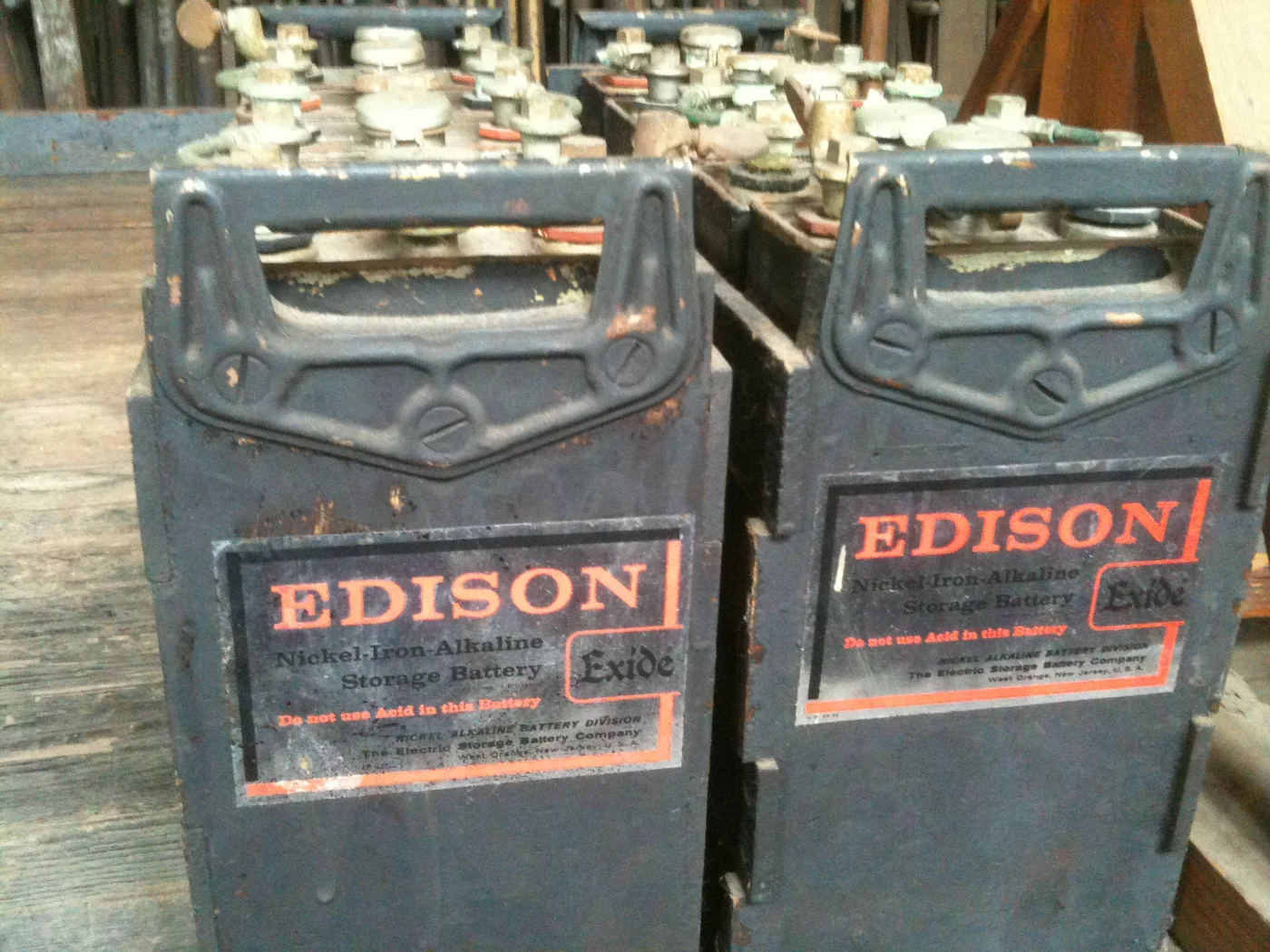
Iron-nickel battery lifespan: 30-50 years. There are documented cases of iron-nickel cells Edison built in 1901 that still work today. Just top off the electrolyte (KOH aqueous solution) every 10-15 years, and the electrodes are virtually permanent.
The only battery chemistry that enables zero replacements within a module’s design life.
Safety – Fire in Vacuum Means Death
The organic electrolyte in lithium-ion batteries is flammable. On overcharge, physical damage, or internal short:
Internal temperature rise -> separator shrinkage -> short-circuit expansion -> electrolyte decomposition
-> flammable gas release -> ignition -> cascading thermal runaway to adjacent cells
Earth: fire trucks arrive. Space: there are no fire trucks in vacuum. Fire in a sealed module = life support loss + toxic gas filling + no rescue.
Even on the ISS, lithium-ion fire is one of the most feared scenarios. Install lithium-ion across thousands of Dyson modules, and fire becomes a statistical certainty.
Intrinsic safety of iron-nickel:
- Electrolyte: potassium hydroxide aqueous solution – water-based. It does not burn
- On overcharge: water electrolyzes into H₂ + O₂ – not thermal runaway
- On over-discharge: no irreversible electrode damage – recoverable by recharging
- On physical damage: KOH leaks – corrosive but no explosion or fire
“A battery that doesn’t catch fire” is not a luxury in space – it’s a necessity.
Battolyser – A Battery That Also Does Electrolysis
This is where iron-nickel goes beyond being a mere “second choice” to having a unique advantage.
Principle
The Battolyser concept developed by TU Delft. It actively exploits iron-nickel batteries’ overcharge tolerance:
[Charging]        Electrical energy -> stored as chemical energy in Fe/Ni electrodes
[After full charge] Additional current -> electrolyzes water in KOH aqueous solution
                    Cathode: 2H₂O + 2e⁻ -> H₂↑ + 2OH⁻
                    Anode: 2OH⁻ -> ½O₂↑ + H₂O + 2e⁻
One device serves as both battery + electrolyzer. No separate electrolysis equipment needed. Mass, volume, and complexity savings.
In lithium-ion, overcharge = fire. In iron-nickel, overcharge = hydrogen production.
Operational Cycle in a Dyson Module
[Normal operation] Turbine running at 370 MW
  |-> Load consumption (~320 MW)
  |-> Surplus power (~50 MW) -> Battolyser mode
       |-> H₂ ~890 kg/h + O₂ ~7,100 kg/h accumulation (assuming ~70% electrolysis efficiency)

[Eclipse] 3-12 hours/year
  |-> Battery discharge (ESS mode)
  |-> Stored H₂ -> fuel cell generation (parallel)
       -> 2x+ available energy vs battery alone

[Emergency shutdown]
  |-> H₂/O₂ dual storage -> extended life support
Beyond Energy Storage
The H₂ and O₂ produced by the battolyser go beyond simple energy storage to integrate into the entire module’s material cycle:
| Output | Application | Notes |
|---|---|---|
| H₂ | NTP tug propellant replenishment | Working fluid for nuclear thermal propulsion |
| H₂ | Smelting process reducing agent | Metal oxide -> pure metal (FeO + H₂ -> Fe + H₂O) |
| H₂ | Fuel cell emergency power | Backup power during eclipse/maintenance |
| H₂ | Haber-Bosch -> NH₃ -> fertilizer | Habitat module agriculture |
| O₂ | Life support (breathing) | Essential for habitat modules |
| O₂ | Oxidizer (welding, medical) | Local manufacturing processes |
A battery that stores energy while simultaneously producing propellant, reducing agent, and breathable oxygen. Lithium-ion only stores electricity.
“Isn’t 1/10 the Energy Density Way Too Bulky?”
Yes. To store the same energy, iron-nickel needs 5-10x the volume of lithium-ion.
But:
Dyson module scale:
  Mirror: 1 km x 1 km = 1,000,000 m²
  Structure: extends several km behind the mirror
  Total volume: millions of m³

Required ESS capacity (12 hours x 370 MW):
  4,440 MWh = 4,440,000 kWh

Iron-nickel (at 40 Wh/L):
  111,000 m³ = 111 m x 111 m x 9 m

-> Less than 1% of total structure
In the millions of m³ of structure behind a 1 km² mirror, 111,000 m³ is one small corner. Moreover, the heavy mass of iron-nickel can serve as a counterweight for rotating structures. The disadvantage flips into an advantage.
The high self-discharge rate of ~1% per day is only a problem on the ground. With turbines running 24/7/365, the battery is always charging. Self-discharge is meaningless.
“Can’t you just increase turbine output and skip ESS?” Eclipse and emergency shutdowns are situations where turbines stop entirely. Generation and storage are separate problems.
Space Environment Adaptation Design
You cannot simply bring a terrestrial iron-nickel battery to space. Three adaptations are needed.
1. Electrolyte Evaporation Prevention
KOH aqueous solution loses water through evaporation in vacuum. Sealed cell structure is mandatory. Fortunately, battery cells are designed to be sealed by default. For space use, only the sealing level needs reinforcement.
2. Zero-Gravity Gas Separation
In battolyser mode, H₂/O₂ bubbles cling to electrode surfaces. On Earth, buoyancy lifts bubbles away, but in zero gravity this doesn’t work.
Solution: Hydrophobic coating on electrode surfaces + centrifugal force from module rotation for gas separation. A centrifugal acceleration of just ~0.01G is sufficient for bubble separation.
3. Radiation Tolerance
KOH aqueous solution is extremely stable against radiation unlike organic electrolytes. Organic electrolytes degrade as radiation breaks molecular chains. Aqueous solution experiences minor water radiolysis from radiation, but natural recombination restores it. In a radiation environment, iron-nickel is inherently superior to lithium-ion.
One-Line Summary
Lithium-ion is Earth’s best battery. But there is no lithium on asteroids, you can’t swap batteries every 10 years in space, and you can’t extinguish fires in vacuum. Iron-nickel batteries can be made from asteroid smelting byproducts, last 30-50 years without replacement, don’t catch fire, and after full charge transform into an electrolyzer that produces propellant and breathable oxygen. The 1/10 energy density is meaningless at the 1 km² scale.
For terrestrial applications of iron-nickel batteries, see Iron-Nickel Batteries as Off-Grid ESS.