 DABEL5
“If you have a Dyson swarm, where do people live?”
We’ve shown designs for climate control, asteroid mining, and mirrors that build mirrors. A natural follow-up question arises: so where do people actually live?
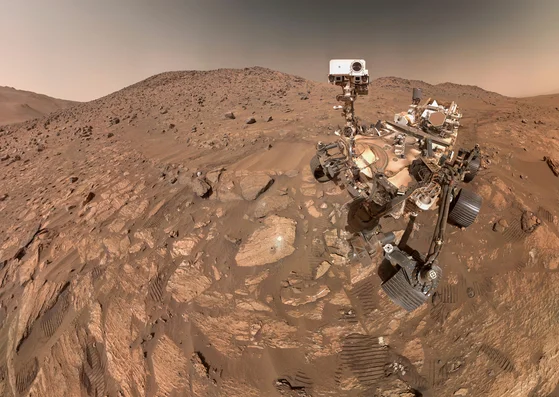
Most people answer “Mars.” Decades of science fiction have cemented the image. SpaceX is building the rockets. Mars as humanity’s second home — it’s practically taken for granted.
But when you run the engineering, Mars has fatal flaws as a human habitat. And those flaws can’t be fixed with technology.
0.38G — The Number Nobody Knows
Mars surface gravity is 0.38G. That’s 38% of Earth’s. “It has gravity, so it’s fine, right?” is easy to assume, but the problem is how much.
Human bones, muscles, the cardiovascular system, and the inner ear (vestibular organs) evolved optimized for 1G. Astronauts who spend six months at 0G on the ISS suffer bone density loss, muscle atrophy, and vision degradation. We know 0G is bad.
What about 0.38G?
Honest answer: nobody knows.
- NASA and ESA space medicine data has only two data points: 0G (ISS) and 1G (Earth)
- Whether mammalian pregnancy, fetal skeletal formation, inner ear development, and cardiovascular formation proceed normally at 0.38G has never been tested — not even once
- We don’t know if the bones and muscles of a child born and raised at 0.38G could withstand 1G
- If they can’t, a human born on Mars can never come to Earth
This isn’t a technology problem. You can’t change Mars’s mass. 0.38G is a physical constant of the planet Mars.
O’Neill Cylinder: Choose Your Gravity
A rotating cylindrical structure — the O’Neill cylinder. By adjusting the rotation radius and angular velocity, you can generate precisely the gravity you want through centrifugal force inside.
| Mars | O’Neill Cylinder | |
|---|---|---|
| Gravity | 0.38G (fixed) | 0.5-1.5G (selectable) |
| 1G guarantee | Impossible | Guaranteed by adjusting rotation speed |
| Intergenerational health | Unknown | Same conditions as Earth |
| Return to Earth possible | Uncertain | Guaranteed |
Mars’s advantage isn’t “it has gravity” — the problem is “the gravity is ambiguous.” An O’Neill cylinder makes gravity a design variable.
Energy: Right Next to the Dyson Modules
If you build a city on Mars, where does the energy come from?
| Mars | L5 (next to Dyson modules) | |
|---|---|---|
| Solar flux | 589 W/m² (43% of Earth’s) | 1,361 W/m² (100%) |
| Available time | Daytime only (blocked for months during dust storms) | 365 days, 24 hours, uninterrupted |
| Energy infrastructure | Build power plants from scratch | Direct supply from Dyson modules |
At L5, the habitat module is part of a Dyson module cluster:
Dyson module (370 MW electric)
    |-> Electricity -> Life support, agricultural lighting, residential power
    |-> Thermal cascade
         |-> 100-200°C -> Habitat heating & hot water (free)
         |-> 30-60°C -> Data center environmental heat
One module produces 370 MW electric for 3,000 residents. ~120 kW per person. That’s more than 10 times the average power consumption of developed nations on Earth. The habitat’s energy is just a side function of the Dyson module — no separate power plant needed.
To supply the same level of energy on Mars? You’d have to build massive solar arrays in the middle of dust storms. And they shut down at night.
Industry: The Factory Already Exists
To build a city on Mars, you first need to build factories. Construction materials, consumer goods, electronic components, medical equipment — all of it must either be shipped from Earth or built from scratch on Mars.
Mars’s industrial environment:
- Atmosphere: 95% CO₂, pressure 0.6% of Earth’s -> no outdoor activity without a spacesuit
- Water: exists in polar ice caps, but requires extraction and purification infrastructure
- Raw materials: present, but mining at the bottom of a gravity well -> enormous cost to lift to orbit
L5’s industrial environment:
- The Dyson module cluster is itself an industrial park
- Smelting modules -> structural materials, pipes, batteries
- Fab modules -> electronic components, sensors, AI chips
- Structural modules -> habitat expansion elements
- Daily necessities (clothing, tools, medical devices) manufactured locally
To build a city on Mars, you’d need to build factories first. At L5, the factories are already running. Adding a habitat module is closer to adding a room to an existing production line.
Communications: Mars’s Isolation
From here, it’s not about technical impossibility — it’s about quality of life. But you can’t discuss a civilization’s habitat without considering quality of life.
| Mars | L5 (SEL5) | |
|---|---|---|
| Communication delay to Earth | 4-24 min (one-way, varies by position) | ~8 min 20 sec (one-way, constant) |
| Communication blackout | ~2 weeks total blackout during conjunction | None |
| Real-time conversation | Impossible (8-48 min round-trip) | Impossible (~17 min round-trip) |
Neither allows real-time calls. But Mars has periods of complete disconnection from Earth for two weeks. L5 doesn’t.
And the decisive difference: L5’s residential hub can be placed not at SEL5 but at EML4/5.
EML4/5 residential hub
  |-> Communication to Earth: ~2.6 sec round-trip (real-time video calls possible!)
  |-> Shift rotation shuttles to SEL5 industrial park
  |-> 2-3 days to the Moon (logistics & tourism)
At 2.6 seconds round-trip from EML4/5 to Earth, you can make a phone call. There’s no comparison with Mars.
Return: Mars Is Effectively One-Way
To return from Mars to Earth:
- Mars surface -> Mars orbit: Δv ~3.8 km/s
- Mars orbit -> Earth orbit: Δv ~2 km/s or more
- Total Δv ~5.7 km/s + 9 months travel time
- Launch window: once every 26 months
Economically and psychologically, Mars migration is one-way. “You can always come back” is only theoretically true — practically, it’s nearly impossible.
L5 -> Earth:
- EML residential hub to Earth orbit: Δv < ~1 km/s
- Logistics infrastructure (tugs, shuttles) already exists
- Regular shuttle service possible
Going to Mars means “emigrating.” Going to L5 means “a business trip” or “relocating.” Whether you can come back or not is a fundamental difference in choosing a habitat.
The Fantasy of Terraforming
“Can’t we just terraform Mars?”
Terraforming reality:
- Time: hundreds to thousands of years. Even optimistic estimates say at least several centuries
- Atmosphere retention: Mars has no Earth-like magnetic field. Solar wind continuously strips the atmosphere. Even if you create an atmosphere, there’s no certain way to maintain it
- Gravity: even with a full atmosphere, 0.38G doesn’t change. Even if the atmosphere becomes as thick as Earth’s, the gravity problem remains
O’Neill cylinders:
- 1 atm, 1G immediately upon construction
- Mountains, rivers, and sky can be built inside (interior landscape design)
- Any desired ecosystem implemented immediately
- No need to wait for terraforming
While waiting centuries for terraforming to complete, people in O’Neill cylinders are already living there.
“But I Still Want to Live on a Planet”
Engineering arguments alone don’t cover everything. The psychological comfort of having a planet beneath your feet. A sky and horizon visible through the window. That’s acknowledged.
But a few points:
“Mars is resource-rich” — Asteroids have better accessibility for resources. Mars sits at the bottom of a gravity well, requiring enormous energy to lift mined resources to orbit. Asteroids have virtually no gravity — you just take what you need.
“O’Neill cylinders are too small” — Scale up the module count. 10,000 modules means 30 million people. Self-replication scales exponentially, so L5’s population exceeds Mars long before terraforming is complete.
“Psychologically, we need a planet” — Mountains, rivers, and clouds can be built inside an O’Neill cylinder. A cylinder with a radius of several km even has a sky. Whether the view out the window is Mars’s red desert or an O’Neill cylinder’s engineered nature — that may be a matter of taste, but the engineering superiority is clear.
“SpaceX is already investing” — Mars exploration and Mars habitation are different problems. An exploration base is like Korea’s Sejong Station in Antarctica. Nobody’s proposing to build a civilization there. Exploration base ≠ civilization’s habitat.
One-Line Summary
Nobody knows if a child can develop normally in Mars’s 0.38G. An O’Neill cylinder guarantees 1G. Energy comes directly from Dyson modules, factories are already running, and you can even make phone calls to Earth. Mars is romantic; L5 is engineered.